South Tacoma Tree Canopy Project
Contact
Mike Carey
Urban Forest Program Manager
mcarey@tacoma.gov
(253) 404-6989
Read the press release: On Tuesday, June 23, Tacoma City Council Authorized $1.75 Million South Tacoma Tree Canopy Enhancement Partnership with Washington Department of Ecology
The City’s portion of the work focuses on tree canopy expansion within the settlement area, with added attention to the South Union Avenue primary truck route. While The Washington State Department of Ecology manages the overall settlement and broader use of funds, this webpage focuses on the City of Tacoma’s role in this work. Visit the Department of Ecology webpage to learn more about their role.
Background
In November 2024, Ecology reached an $8.95 million settlement with Bridge Point Tacoma to address air and stormwater pollution impacts in South Tacoma related to the increase in traffic and exhaust emissions from the warehouse development. These funds will be used to make improvements to the neighborhood to help reduce air quality impacts and monitor air quality in the surrounding community, with priority given to areas most affected by truck traffic. Robust community engagement by Ecology and other organizations working in the neighborhood supported several strategies, including planting trees along truck routes.
Ecology and the City’s Urban Forestry Program developed a partnership to support implementation specific tree canopy and related site improvement work within the settlement area, including tree inventory and analysis, a neighborhood tree planting program, and planning and construction of capital improvements along South Union Avenue. Trees are one of several approaches being used to help respond to air quality concerns in the project area.
 Project Area
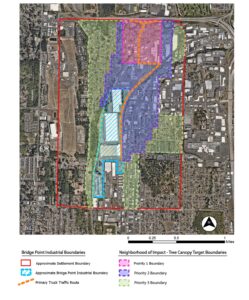
The settlement agreement between Bridge Point and the Department of Ecology requires the settlement money to be spent within a specific defined area of impact, knows as the “settlement boundary” in South Tacoma. Ecology conducted modeling to determine where within this settlement boundary the air quality impacts would be the greatest, which became the bases of the “priority zones” within the partnership between Ecology and the City’s Urban Forestry Team (refer to map). Work will be prioritized in Priority 1, Priority 2, and Priority 3 zones according to the level of investment and impact.
What the City is Doing
The City’s Urban Forestry Program is leading the implementation of tree canopy improvements, which includes three main phases:
- Tree inventory and planting analysis
This first phase will help determine what tree planting opportunities exist in the neighborhood, and how to tailor an approach to increase tree canopy that is responsive to the neighborhood. This tree inventory and analysis within the settlement area will identify existing trees, possible planting locations, and sites that may be suitable for future improvements, which will help guide where planting can happen and where constraints such as utilities, spacing, or site conditions need to be considered. - Green Blocks tree planting program
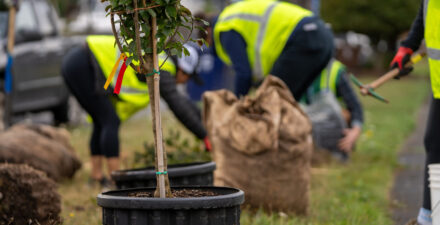
The second phase is a neighborhood tree planting program based on the Green Blocks model, a partnership with the City’s Urban Forestry Program and the Tacoma Tree Foundation. This will include outreach to eligible households, free street trees and private property trees for participating residents, and community planting activities. An estimated 600 residential properties may be eligible for this free tree program, which includes free planting assistance for those who would like support. The Phase One tree planting analysis will also identify potential “depave” sites, where the City can provide support with the removal of impervious surfaces like asphalt and gravel to create new tree planting opportunities. - South Union Avenue capital improvements
The third phase includes the planning and construction of capital improvements along South Union Avenue, the primary truck corridor. While the final improvements are not yet designed, the concept includes planting strip improvements, conversion of unused central roadway space into a planted median, and a possible small landscaped public space near South 30th Street. Final design and construction details will be developed in 2027, with construction anticipated for 2028.
Timeline Overview
-
2026
-
- Interagency Agreement with Ecology and the City finalized (mid 2026)
- Tree inventory and analysis (mid 2026)
-
2027
-
- Green Blocks community tree planting program (summer – winter 2027)
- Design engineering for South Union Avenue capital improvements begins (mid 2027)
-
2028
-
- Green Blocks follow-up outreach and watering materials distributed (early-mid 2028)
- Construction for South Union Avenue capital improvements (summer through fall 2028)
- Community depave, landscaping and tree planting
- Project summary and final participation reporting are completed (late 2028)
Note: Project timing may change as design, permitting, and construction move forward.
What Residents Can Expect
As the project moves forward, residents in eligible areas may see:
- mailed information about the program
- outreach from the City, Ecology, and project partners
- opportunities to request free trees for eligible properties
- community planting events
- planning and construction activity along parts of South Union Avenue
Note: Some tree planting and related work in the public right of way may require permits, utility locating, and property owner consent before work can move forward. Ongoing watering of planted trees will also be important during the establishment period.
Funding
This work is funded through the Washington State Department of Ecology’s settlement with Bridge Point Tacoma. The City’s Urban Forestry work is being carried out through an interagency agreement with Ecology.
Additional Information
Frequently Asked Questions
-
Both the City of Tacoma and Ecology have developed individual webpages to help clarify roles and involvement in the Bridge Point Tacoma development, settlement, and mitigation work. Follow these links to find out the details:
- City of Tacoma Bridge Industrial Warehouse Project website
- Department of Ecology Bridge Point South Tacoma Warehouse Settlement website
- City of Tacoma South Tacoma Tree Canopy Project website
-
This project is made possible by the legal agreement between Bridge Point Tacoma and Ecology. The agreement provides funds to Ecology to help mitigate traffic and air quality impacts of the Bridge Point industrial development within a portion of South Tacoma known as the “Settlement Boundary.” The Settlement Boundary is defined as the area located south of Washington State Route 16, west of South Pine Street, north of South 56th Street, and east of the Tacoma Recovery & Transfer Center at 3510 S Mullen St.
This location includes areas of South Tacoma that may be the most impacted by the future truck traffic routes, as determined during the permitting process for Bridge Point. This project deploys green infrastructure investments directly to the neighborhood of impact, utilizing trees as air filters to mitigate these localized environmental and health impacts caused by the increase in new heavy truck traffic.
-
The language in the Settlement Agreement states that one of the acceptable uses of funds is for “Other measures to maintain or improve traffic and air quality in South Tacoma, that are specifically requested by South Tacoma residents pursuant to outreach by Ecology…”
In June 2025, Ecology worked with the Voice Tacoma Creative Media community group to conduct home visits to residences along the future primary truck traffic route (along South Union Ave). This included over 100 residences. . Through these visits and surveys, Ecology collected information about how residents wanted the settlement funds to be spent. Some specific options that were supported by residents include weatherizing homes, providing air cleaners and replacement filters, and planting trees near the project site. This input was used to guide Ecology’s spending, including supporting this specific tree planting program. While this page focuses on the City-led tree planting portions of the project, you can view the full scope of mitigation work on the Department of Ecology webpage.
-
The Department of Ecology and City of Tacoma’s Urban Forestry Program have developed a partnership to leverage each other’s strengths, existing programs, and partnerships to provide the best services to the South Tacoma Community. This partnership allows us to provide better outcomes and reduce costs associated with doing the work independently. Ecology has a well-established air quality program that specializes in parts of the scope identified in the Settlement Agreement, such as air quality monitoring and partnering with weatherization experts to help households with partial weatherization and air filtration improvements. The City of Tacoma’s Urban Forestry program has well-established tree planting programs and critical partnerships with the Tacoma Tree Foundation, Pierce Conservation District, and tree contractors to provide services such as depave and Green Blocks. Working together allows these organizations to leverage existing program resources which will reduce the amount of the Settlement Funds that would otherwise need to be used to establish new programs, partnerships, and contracts.
-
An Interagency Agreement (IAA) is a formal, written contract between two government agencies that allows them to share resources, transfer funds, or collaborate on projects of mutual interest. It allows one agency (the servicing agency, Tacoma) to provide goods, services, or equipment to another (the requesting agency, Ecology) to accomplish a specific mission efficiently. The IAA allows for Ecology to use the services of Tacoma’s Urban Forestry Program to administer the tree canopy mitigation work and allows the funding to be distributed through the City to subcontractors and to purchase the materials and equipment necessary to support the program.
-
Ecology and the City met to discuss the current urban forestry program services the City provides to the community and discussed opportunities to meet the requirements of the Settlement Agreement, and to be responsive to the comments and recommendations received from the impacted community.
The services that fit well into this scope of work included:
- an inventory and assessment to better understand the opportunities to depave and plant trees within the impacted neighborhood,
- to provide a free tree program for streets and residential properties, and
- to build a capital project that focuses on removing pavement and planting trees and green space along the primary truck traffic corridor.
These scopes of work were then provided to the City’s subcontractors to get an estimate to perform the work. The City’s Public Works Engineering team put together a preliminary design and estimated construction costs for the capital improvements. These estimates were used to determine the $1.75M project scope and budget.
-
The project boundary was determined based on potential future impacts and prioritizes the areas with the highest exposure to air pollution as a result of the new heavy truck traffic (South Union Ave). While the primary investment will focus on the areas of greatest impact, the entire Settlement Boundary will be eligible for tree planting.
-
This project is funded by a $1.75 million allocation from the Department of Ecology’s $8.95 million settlement with Bridge Point Tacoma. No local tax increases or City general funds are being used to support this work. Additionally, the City is contributing staff time – not paid through these funds – to manage the tree canopy enhancements in the project, as well as contributing the City’s missing link sidewalk program funds to support complete streets design in the primary truck corridor.
-
The City of Tacoma’s Urban Forestry Program and the Tacoma Tree Foundation partner annually on a program called “Green Blocks”, which prioritizes one to two priority neighborhoods per year for a large community tree planting effort. The “2027 Oakland Madrona Neighborhood Green Blocks” free street tree program that will be delivered as a part of this South Tacoma Tree Canopy project is above and beyond what Tacoma has already budgeted during the term of this program. In 2026, the Green Blocks free street tree program will be in the South Tacoma neighborhood directly south of the Settlement Boundary. You can learn more about getting free trees through the 2026 South Tacoma Green Blocks program website.
-
If you live within the designated project area, you will receive a registration postcard in the mail in summer of 2027 to request your free tree and delivery or planting assistance, if desired. If you rent your home, you can still get a tree, but the City would need your property owner’s partnership. Because consent from the abutting property owner is required before planting a street tree or removing asphalt, the Green Blocks program will provide easy-to-share info packets you can hand directly to your landlord outlining the free property value and aesthetic benefits of participation.
-
No. Participation in the Green Blocks program is 100% voluntary. No trees will be planted on private property, and no asphalt, gravel, or other pavement will be removed from your frontage, without the explicit written consent of the property owner.
-
For private residential trees, ongoing watering and care is the responsibility of the homeowner. To support success, the program provides free watering bags to maximize efficiency, minimize water waste, reduce time it takes to water, and help establish the tree’s root systems. These high-efficiency watering bags typically only need to be filled just once a week during the dry season (April through September).
-
All trees planted as part of the South Union Avenue capital improvements—including the new center medians, expanded sidewalk strips, and the new parklet—will be watered, monitored, and maintained by City staff or designated contractors for a full 3-year establishment period. Following this establishment period, the City will assume permanent, long-term maintenance responsibility for the medians.
-
The project will only convert unused portions of the central asphalt turn lane into a planted median. Turning capacity at intersections and critical business access points will remain completely intact, while the new median will calm traffic, capture road emissions, and cool our streets for a safer and more pleasant pedestrian experience.
-
he right-of-way parking lot at South 30th Street is being optimized into a pocket parklet to break up heavy industrial heat absorption. Street parking and vehicle turnarounds will be maintained on South 30th Street. This conversion swaps an underutilized patch of asphalt for community green space, complete with trees, shrubs, and public landscaping.
-
South Union Avenue is a critical freight and commercial corridor. That’s why all construction plans go through a rigorous City traffic engineering review to ensure necessary commercial turning radii and intersection functionality remain completely intact. Construction phasing will be designed to keep access open, and project managers will engage directly with adjacent businesses before breaking ground on the medians or parklet. During the capital construction phase, the City will provide adjacent businesses with a two-week look-ahead schedule for any lane shifts and establish a direct point-of-contact for immediate troubleshooting.
-
The website is live and will be updated with progress throughout the project duration, including a schedule of planned activities. Field mapping begins late summer 2026, neighborhood tree distributions roll out in mid-2027, and capital right-of-way construction along South Union Avenue will conclude by December 31, 2028.
-
The City and Ecology are developing an engagement plan with our partners to identify the best opportunities for community involvement over the next few years. There will be many opportunities to engage during Phase 2 (Green Blocks) and Phase 3 (Capital Project and Depave). This webpage will continue to be updated with the latest information, reports, and community events, and is a great place to check in and continue to stay informed.
Bridge Industrial Warehouse Project
SafeTREE Routes to School