
Encampment Policies and Procedures
Encampments can create a public safety and health concern for both the people living within an encampment and the adjacent community.
Encampment Policies
Unauthorized camping and the storage of personal belongings on public property can create public safety and health hazards, including heightened risk of fires, criminal activities, illegal dumping, and sanitation issues. Unauthorized camping can also interfere with the rights of people to use public areas for their intended purpose.
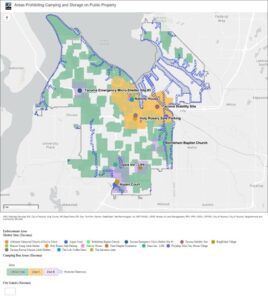
Ordinance No. 29064, passed by City Council on October 21, 2025, and Ordinance No. 28831, passed on October 11, 2022, prohibit camping and the storage of personal belongings on public property within:
- 10 blocks of a Temporary or Emergency Shelter located in the “Downtown Zone,” which includes the area north of S. 38th Street, east of S. Union Street, west of the Puyallup River, and south of Commencement Bay;
- Five blocks of a Temporary Shelter or Emergency Shelter located outside of the “Downtown Zone;” and
- Two blocks of a public school serving grades K-12, public park, or public library.
Areas shaded in the map below show where camping and personal belongs storage is banned under current legislation. Click the image to enlarge.
Encampment Procedures
Encampments are generally reported through Tacoma FIRST 311. Requests are investigated by the City’s Homeless Engagement Alternative Liaison (HEAL) Team. The HEAL Team responds to requests on City of Tacoma public property. Encampments not located on public property are referred to the appropriate department or jurisdiction.
The HEAL Team offers services to residents at encampments, while letting them know the consequences for not complying with encampment removal. As part of our Alternative Response programming, we take a services first approach to homelessness and encampments. It is the City’s priority that the least restrictive voluntary compliance methods possible are used before enforcement of the ordinance, which has a maximum fine of $250 and a maximum allowable time for imprisonment of 30 days or less. Tacoma Police Department leads any enforcement efforts, while the HEAL teams offers shelter and supportive services options.
When an encampment is going to be removed, notices are posted at the encampment as soon as possible and in compliance with applicable City ordinances. The notice will contain:
- The date and time the notice was posted;
- The date and time that removal of the encampment is scheduled;
- A warning that garbage, debris, waste, litter and abandoned property will be disposed of immediately;
- The location where any personal property remaining may be stored by the City if removed;
- Information on how personal property may be claimed;
- Contact information for an outreach provider that can provide shelter alternatives.
Removal notices will be posted at the encampment in locations where they are most likely to be seen, and preferably in multiple locations. If people are present at the encampment, oral notice that the encampment is subject to removal will also be given if reasonably possible. The notice will be printed in English, as well as any other language the City determines would increase understanding of and compliance with the notice and encampment removal process.
Frequently Asked Questions
-
Information in the Standard Operating Procedure (SOP) applies to the unauthorized camping or storage of personal property on public property within prohibited areas covered by Chapter 8.19 of the Tacoma Municipal Code (TMC) only. Encampments outside of these prohibited areas shall be addressed under the City’s Encampment Enforcement and Removal Policies and Procedures. Both policies are subject to change.
-
The City’s process for addressing encampments and reclaiming sites is highly collaborative and carefully considered.
- Outreach First: Before encampment removal begins, our HEAL team visits the site to engage with individuals and offer connection to shelter and resources. The City’s goal is to transition unhoused residents into shelter or housing before an encampment is removed.
- How Encampment Removals Work: Our approach is designed to balance public health and safety with compassionate outreach and respectful treatment of all individuals involved.
Phase 1: Initial Outreach – Before any removal actions are scheduled, initial rounds of outreach are consistently offered to individuals residing at the site to connect them with available resources and shelter options.
Phase 2: Official Notice and Continued Outreach – Following the initial outreach the HEAL team posts official notices, providing as much notice as is possible and reasonable and in compliance with city ordinances given the circumstances. These notices clearly outline the removal process and relevant timelines, the specific legal statutes under which the removal is being enacted, and instructions on how individuals can retrieve any stored belongings after the site is cleared. During this phase, the HEAL team continues to offer outreach and resources.
Phase 3: Day of Removal – On the posted date of the removal, the HEAL team continues to offer outreach and resources, while police officers and contracted waste professionals work to safely and respectfully move structures, waste, storable belongings and individuals from the site. When personal items are removed from an encampment, they are moved to storage at 1421 Puyallup Avenue unless the owner of the items is otherwise notified. Owners of the personal items can then make an appointment through Tacoma FIRST 311 to access and retrieve their stored items.
Phase 4: Post-Removal Communication – Once the area has been completely cleared, post-removal notices are placed at the site. This serves to inform the public that a removal has taken place and provides directions on where to find additional information or request assistance.
-
Site Reclamation is the process of making public and private spaces safer and more welcoming while discouraging criminal activity and loitering. Site Reclamation is used in conjunction with community outreach and service delivery to help individuals and families who are experiencing homelessness access shelter, as well as revitalizing the area and increasing public health and safety.
-
Yes. In October 2025, the Tacoma City Council updated Title 8 of the Municipal Code, relating to camping and storage of personal belongings on public property. Like violations of other laws, violations of Tacoma’s encampment laws can lead to arrest. It is important to note, however, that the City of Tacoma strives for a services first approach, meaning that we first seek to connect people experiencing homelessness to a variety of services, from emergency shelter to behavioral health and seek voluntary compliance with the municipal code.