Automated Enforcement Cameras
Automated enforcement is an important tool in advancing the City’s Vision Zero goal of eliminating fatal and serious injury crashes by 2035. While redesigning roadways for lower speeds and safer conditions remains one of the most effective long-term solutions, automated enforcement provides a more immediate way to improve safety. Research shows this technology reduces average travel speeds, lowers crash rates, and encourages safer driving behaviors at locations where cameras are installed.
**Cameras at Norpoint Way NE and SR-509 are set to go live on September 14, 2026.**
Received a citation? Learn what you can do.
Background
Tacoma’s Automated Enforcement Program began in 2008, initially fully managed by the Tacoma Police Department. In 2021, program administration and financial responsibility was transitioned to the Public Works Department. The Tacoma Police Department continues to support the program administration through reviewing citations. The City of Tacoma is currently expanding the program in line with recent legislation, with additional details available on the Tacoma’s New Speed Safety Cameras web page.
The City contracts with an automated enforcement vendor to provide and operate photo enforcement technology, including the cameras, software, and processing systems. The vendor also mails citations approved by enforcement personnel. The vendor supports program administration while the City retains oversight and directs revenues toward safety improvements.
Automated Enforcement Technology
Automated enforcement cameras capture photos or video of vehicles to check for traffic violations like speeding or running red lights. Tacoma’s system uses radar, which measures speed through the Doppler Effect—sending radio waves and detecting frequency changes as they bounce off moving vehicles.
When a car exceeds the speed limit, the radar triggers the camera to record, using a flash for clear images at night or in bad weather. The equipment works in all conditions and isn’t hardwired, making it flexible and easy to set up where needed.
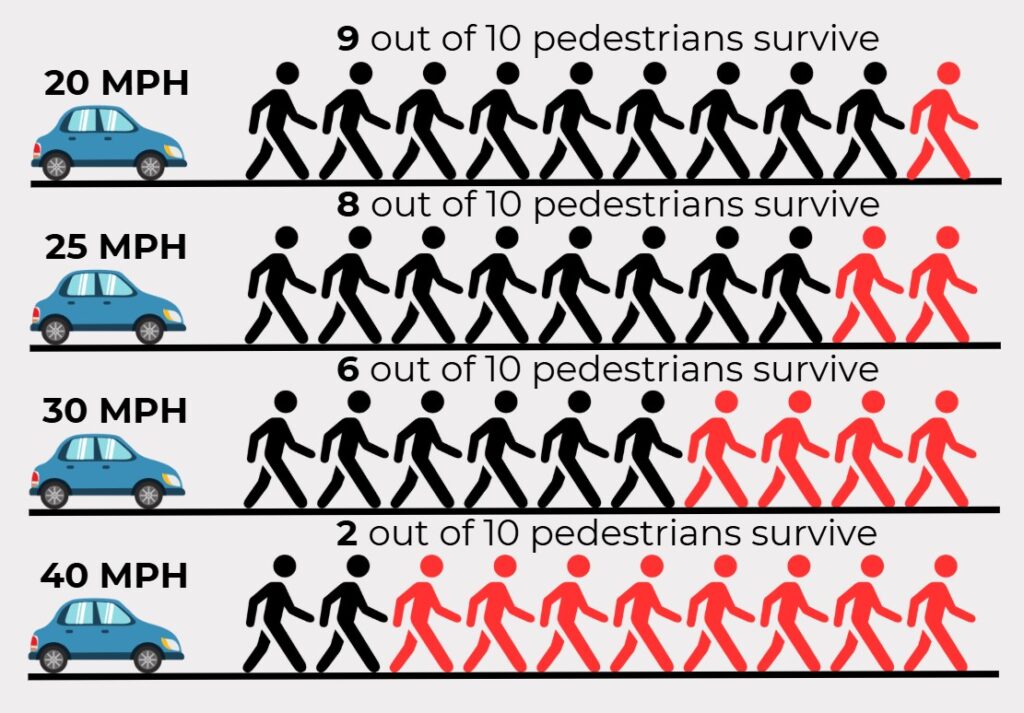
Why does speeding matter?
Vehicle speed has a direct impact on pedestrian survival in a crash:
Automated Enforcement Camera Locations
Tacoma’s Automated Enforcement Program includes speed safety cameras, school zone speed cameras, and red-light cameras located throughout the city.
Current Camera Locations
| Type | Location | Direction |
|---|---|---|
| Speed | 2990 block of Bay Street (SR 167) | Northbound |
| Speed | 1800 block of Norpoint Way NE | Eastbound |
| Speed | 1900 block of Marine View Dr (SR 509) | Northbound |
| School Zone | 5200 block of Pacific Avenue | Northbound |
| School Zone | 5500 block of Pacific Avenue | Southbound |
| School Zone | 5100 block of North 26th Street | Westbound |
| School Zone | 5100 block of North 26th Street | Eastbound |
| Red Light | East 38th Street & East McKinley Avenue | Eastbound |
| Red Light | South 56th Street & South Oakes Street | Eastbound |
| Red Light | South 56th Street & South Tacoma Way | Westbound |
| Red Light | South 74th Street & South Tacoma Way | Eastbound |
| Red Light | South Tacoma Way & South 74th Street | Southbound |
| Red Light | South Hosmer Street & South 84th Street | Northbound |
| Red Light | Pacific Avenue & South 72nd Street | Southbound |
| Red Light | Pacific Avenue & South 72nd Street | Northbound |
| Red Light | North Pearl Street & North 26th Street | Southbound |
Expanding Automated Enforcement
In 2024, the Legislature passed House Bill 2384 which broadened the authority for local jurisdictions to use automated enforcement. The bill expanded eligible camera types and locations beyond school zones and red-light intersections to now include high-crash locations, park zones, and hospital zones.
Automated Enforcement Task Force
To guide the expansion effort, Public Works convened an Automated Enforcement Task Force composed of community members representing a broad range of perspectives. Staff from the Office of Equity and Human Rights, Tacoma Police Department, and Public Works Department participated as well.
Over the course of six meetings, the Task Force members discussed balancing equity and effectiveness. Overall, the Task Force strongly recommended a data-driven approach to site selection and clear, consistent communication and outreach to support transparency, build trust, and educate the public on the role of automated enforcement in improving safety.
Expansion of Camera Locations
Since the Automated Enforcement Task Force, staff has since developed a methodology for identifying new locations based on crash and speed data, land use, and other factors.
For the first phase, five locations were identified, with a total of eight speed cameras to be installed:
-
-
- South Sprague Avenue (two cameras, one each direction)
- Pacific Avenue (two cameras, one each direction)
- SR-509 (one camera, southbound direction)
- Norpoint Way NE (one camera, uphill direction)
- Portland Avenue (two cameras, one each direction)
-
New Camera Enforcement Timeline
When a new automated enforcement camera begins operating, the first 30 days are a warning period. During this time, vehicles that commit a violation will receive a warning notice instead of a citation. After the 30-day warning period, violations are subject to a $145 civil infraction. More information on how specific locations were chosen can be found in this ArcGIS StoryMap, which explains the data and process used for location selection: Tacoma’s New Speed Safety Cameras.
Facts Sheets
Learn more about Tacoma’s automated enforcement program. Fact sheets are available in multiple languages.
-
- Automated Enforcement Fact Sheet (English)
- Programa de Control Automatizado (Spanish / Español)
- Chương trình Thực thi Tự động (Vietnamese / Tiếng Việt)
- Програма автоматичної фіксації порушень (Ukrainian / Українська)
- Программа автоматического контроля за исполнением правил дорожного движения (Russian / Русский)
Frequently Asked Questions
-
How to pay your citation
Pay Online
If you wish to pay online using Visa, Mastercard or Debit (Apple Pay is not available at this time), please visit our online payment website.
Pay By Mail
Checks and money orders are accepted by mail. Make all checks and money orders payable to Tacoma Municipal Court. Please include the ticket number on your check or money order. Mail your payments to:
Tacoma Municipal Court
930 Tacoma Avenue South
Room 841
Tacoma, WA 98402Pay In Person
Cash, personal checks, money orders, Visa, MasterCard and Debit are accepted at our service counter on the 8th floor of the County-City Building. Make all checks and money orders payable to Tacoma Municipal Court. Please include the ticket number on your check or money order.
Citation Reduction: Under Washington law, registered vehicle owners who receive public assistance under Title 74 RCW or participate in the Washington WIC (Women, Infants, and Children) Program may qualify for a 50% reduction in the penalty for an automated traffic camera citation.
How to dispute your citation
If you believe your citation was issued in error, you have the right to request a hearing through the court rather than pay the fine.
There are two types of hearings:
- Mitigation Hearing – You admit the violation occurred but want to explain the circumstances.
- Contested Hearing – You believe you did not commit the violation or have a valid defense.
To request a hearing, sign the back of your ticket and mail it to the court, or submit your request in person.
Learn more about the hearing process on the Traffic & Parking Infractions page.
Important: Within 30 days of the citation date (33 days if the citation was mailed), you must either pay the citation or request a hearing.
-
When a driver commits a traffic violation in an area monitored by an automated speed camera, the camera detects it and records the event. Enforcement staff then review the photos and video to determine whether a violation occurred. They base their decision solely on the evidence captured by the camera. If they decide there was no violation, the system deletes the recording. If they confirm a violation, the system sends the record to the court to create a case. After that, a notice of violation is mailed to the registered owner of the vehicle.
-
Automated enforcement tickets do not count as moving violations under State law. Unlike citations issued by police officers, they won’t appear on your driving record and are not reported to insurance companies.
-
State law has built in safeguards for privacy and data protection. Automated enforcement camera systems are governed by RCW 46.63.220 which includes several key data privacy protections:
- Image Restrictions: Cameras may only capture the vehicle and license plate—not faces of drivers or passengers
- Data Use: Images and data are only for authorized city/county use, not public, and not admissible in unrelated court cases
- Retention Limits: Data must be deleted when no longer needed for enforcement
Annual Report
A report must be published annually that includes traffic crash data and the number of citations issued. The report is updated each April or May when the Washington Department of Transportation provides the final crash data.