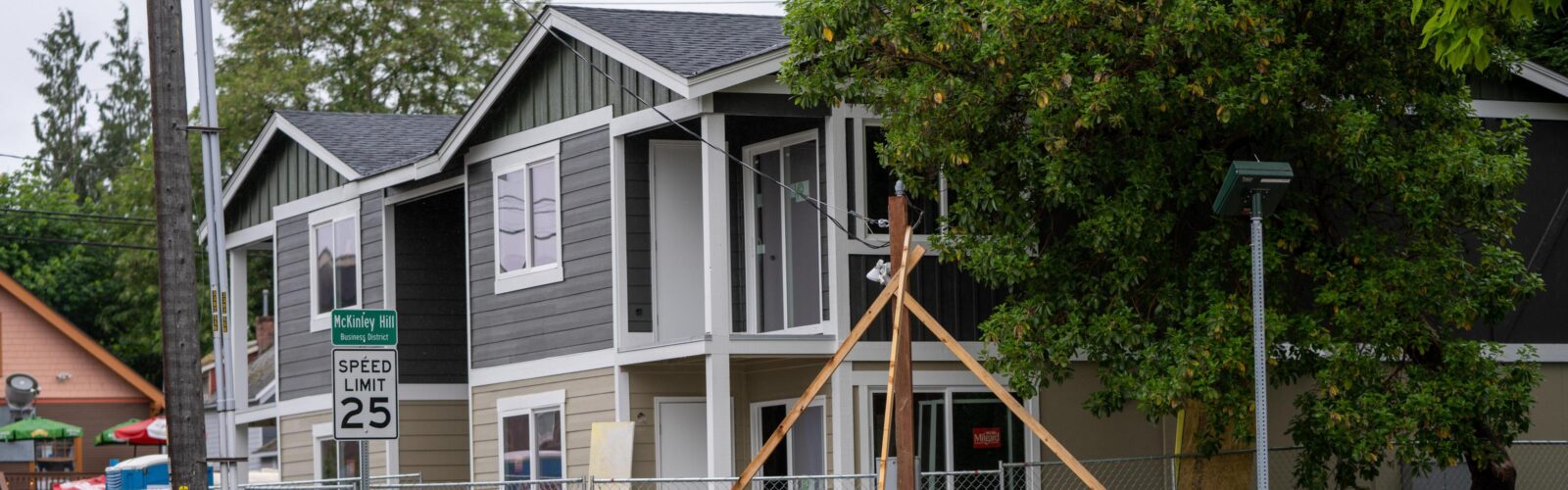
Home in Tacoma: New Residential Zoning & Incentives
On February 1, 2025, the Home in Tacoma zoning regulations went into effect. These changes:
- Expand housing options in our community by allowing accessory dwelling units (ADUs), rowhouses, and a broader range of housing types in all zoning districts.
- Address housing affordability and supply challenges with more flexible and inclusive options.
- Provide enhanced incentives for homeownership and home building.
- Provide updated standards for building size, setbacks, parking, and tree planting and retention.
Learn more about Home in Tacoma implementation and developing under the updated regulations through the resources and information below.
The following information is intended to support residents and developers in understanding the new zoning regulations, building allowances, and connected incentives, which are also summarized in this brochure.
Zoning & Housing Types
-
Traditional single-family zoning has been replaced Citywide by new zoning “Urban Residential Zoning Districts” and development standards that allow for a greater range of housing types and more units per lot. The zoning brings the City of Tacoma into full compliance with recent state legislation, including House Bill 1110, that requires local jurisdictions to allow middle housing in traditional single-family neighborhoods and to increase the number of new housing units allowed per lot.
The new Urban Residential (UR) zones support “middle housing” with two low-scale zones (UR-1 & UR-2) and one mid-scale zone (UR-3). Development standards for each zone establish allowable housing types, uses, density, and scale (maximum height, minimum setbacks, and maximum area). Scale and density increase nearer to walkable community destinations such as schools, parks, and business districts.
-
One of the significant changes enacted through Home in Tacoma is to establish a broader range of housing types that are allowed in traditional single-family neighborhoods. These new housing types also represent a shift in how we think about housing, from who lives in the housing (e.g. single-family, multi-family) to housing types based on the type of structure(s) and building arrangement. These new types include House-plex, backyard building, courtyard housing, rowhouses, and multiplex.
Each of these housing types has standards associated with it that include building placement, orientation, and habitable space along sidewalks; building size; building articulation, transparency, and covered entries; and pedestrian and auto access.
- See the Housing Types in Urban Residential Districts Summary for a breakdown on the five housing types.
- See the Home in Tacoma Development and Design Standards for additional information on the Building Design Standards.
Incentives & Flexibilities
Along with the base zoning districts and housing types, the Home in Tacoma zoning reform also included new incentives and code flexibility for projects that support affordability, homeownership, and tree retention.
-
The affordability bonuses are intended to support the construction of housing affordable to households earning 60% to 80% Pierce County family median income for rentals, and up to 100% Pierce County family median income for ownership. The market feasibility analysis shows middle housing is financially feasible & will increase affordability and choice—but other actions are needed for moderate to low-income households. The HIT Bonus Program (TMC 13.06.020.F.2) can help meet that need and support other goals.
In return for greater unit affordability, new development can receive bonuses for:
- Density
- Building size
- Building height
- Parking reductions
- Multifamily tax exemption
- Reduced setbacks
- Reduced tree canopy
These bonuses work in conjunction with additional City strategies outlined in the Affordable Housing Action Strategy to support a broader affordability initiative. For more information see the Affordability Retention Summary.
-
Incentives for ownership opportunities (TMC 13.06.020.F.4) include flexibilities for certain development standards (listed below) in order to encourage developments that create new homeownership opportunities for owner-occupant households earning no more than 150 percent of the Pierce County family median income for, at least, the first 5-years from certification of occupancy. To ensure compliance, a binding title restriction conforming to City requirements shall be recorded on the property.
The following development standards are modified as incentives for qualifying homeownership projects:
- The rear yard height limit in the UR-1 and UR-2 districts is raised to 35-feet.
- No alley access is required if the alley is not currently developed.
- The on-site tree credit requirement is reduced to the minimum “floor” level without requiring Tree Credit Fees or Canopy Loss Fees.
-
Incentives for accessory dwelling units (TMC 13.06.020.F.5) include flexibilities for certain development standards (listed below)for current owner-occupant households earning no more than 150 percent of the Pierce County family median income. These incentives are available when adding up to two Accessory Dwelling Units (ADUs) on their own property and adding a binding title restriction that one of the units will be owner occupied for, at least, the first 5-years from certification of occupancy.
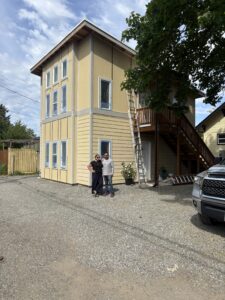
Photo submitted by McKinley Hill homeowners, Tania Lopez and Rigo Montes.
The following development standards are modified as incentives for qualifying homeownership projects:
- The rear yard height limit in the UR-1 and UR-2 districts is raised to 35-feet.
- No alley access is required if the alley is not currently developed.
- The on-site tree credit requirement is reduced to the minimum “floor” level without requiring Tree Credit Fees or Canopy Loss Fees.
- For additional information see:
*Pre-Approved Detached ADU plans are available to streamline permitting and save time and money.
-
Flexibilities for tree retention (TMC 13.06.020.F.3) for certain development standards are available when retaining an existing tree over 12 inches at Diameter at Breast Height*, including the following:
- Height flexibility for retaining at least one tree:
- UR-1 and UR-2 districts: 35 feet tall maximum in rear yard.
- UR-3 district: 45 feet maximum.
- Front and rear setback flexibility:
- UR-1 and UR-2 districts: 10 feet minimum for retaining one tree at least 12” DBH. 5 feet minimum for retaining a tree grove.
- UR-3 district: 7.5 feet minimum for retaining one tree at least 12” DBH. 5 feet minimum for retaining a tree grove.
- Side setback flexibility in all UR districts:
- For retaining at least one tree at least 12” DBH: side setback can be reduced to 5 feet when accessing units, provided that retaining walls, utility meters or other permanent obstructions do not reduce usable width below 4 feet.
- Parking quantity flexibility in all UR districts – see TMC 13.06.090B.3.g.(8) Amenity Space: Tree Summary and Parking Summary.
- Additional information on Landscaping and Trees
- Urban Forest Manual
*Tree credits per inch DBH (diameter at breast height) for retained on-site trees per TMC 13.06.090.B.3.e(2)(b):
- Trees < 6” DBH = 50
- Trees 6” ≤ 12” DBH = 75
- Trees 12” ≤ 24” DBH = 100
- Trees over 24” DBH = 125
- Height flexibility for retaining at least one tree:
-
Home In Tacoma and state law allow lot flexibility and separate ownership of individual units (new or existing) in new UR (Urban Residential) zones to encourage and create new opportunities to create separate lots and promote more homeownership.
- Unit Lot Subdivisions are a way to divide property for separate ownership, potentially with shared access, utilities, and infrastructure.
- Minimum site size for a Unit Lot Subdivision (or minimum “parent lot”) is in the District Standards table.
- Unit lots can be created from the parent lot, provided the overall lot area/density standards are met. The parent lot must meet all standards but unit lots do not have to meet standards.
- Creation of new parent lots is permitted, with a new minimum lot size of 2,500 sq/ft in UR Zones.
- For additional information see Unit Lot Subdivision.
Frequently Asked Questions
-
Home in Tacoma is a citywide zoning reform package designed to increase housing supply, affordability, and choice. It replaces former single‑family zoning with new Urban Residential zones that allow a broader range of housing types, including townhomes, duplexes, multiplexes, and multifamily homes.
-
Tacoma faces significant housing affordability and supply challenges. This policy aims to create a more flexible and inclusive housing framework that supports population growth and improves equitable access to housing.
-
The City is:
- Improving data tracking systems on supply, choice, and affordability.
- Increasing community education and awareness of zoning changes.
- Expecting continued growth in applications and completed projects.
-
How are home occupations or home businesses treated in the Urban Residential Zones?
Home In Tacoma allows more flexibility for non-residential uses within residential areas. This serves multiple purposes within the Home In Tacoma project:
- Supports entrepreneurship by providing residents with an opportunity to use their homes to engage in small scale business activities.
- Reduces traffic congestion and work-related commute trips by providing opportunities for residents to work in their homes.
- Protects neighborhood character by providing standards that ensure residential businesses are a secondary use and do not significantly alter the exterior of the property or affect the residential character of the neighborhood.
- Encourages retention of existing structures to preserve neighborhood character.
There are four ways non-residential uses are allowed within Urban Residential zones:
- Residential Business 1 & 2: Replaces current “Home Occupation” use with some changes, with more flexibility provided through Conditional Use Permit (CUP) review.
- Live/Work: Permits Live/Work use within Urban Residential zones.
- Limited Mixed-Use Residential: Permits limited commercial uses as part of a mixed-use residential building within UR-3 zones.
- Adaptive Reuse of Heritage Buildings: Allows limited commercial uses within “heritage buildings” (at least 50 years old) in Residential zones. Replaces current “Uses in Historic Structures” CUP to include older buildings that are not designated historic landmarks.
- For more information, see the Non-Residential Uses Summary
Program Background & Performance
See below to better understand how Home in Tacoma supports the City’s Affordable Action Strategy and how we will continue to provide performance measurements and data on development trends.
Performance Data
The City is closely monitoring performance to identify learnings and opportunities for improvement and to ensure that it is achieving its intended objectives within the affordable housing strategy.
-
Home in Tacoma and the Affordable Housing Action Strategy
The Home in Tacoma initiative that began in 2019 is directly linked to the City’s Affordable Housing Action Strategy (AHAS). The legislative package of amended zoning and standards approved by the City Council in November 2024 is most closely linked to AHAS Objective 1: The creation of new affordable housing. Learn more about the full Affordable Housing Action Strategy and other initiatives and efforts by the City to address the affordable housing gap in Tacoma on the Affordable Housing Action Strategy web page.
-
Since implementation of the updated framework (February 2025–January 2026), permit activity within the new Urban Residential zones included:
- 213 total permit applications
- 385 housing units proposed
- 39% increase in applications (compared to the previous five‑year average)
- 62% increase in total proposed units (compared to the previous five‑year average)
- 16% increase in units per application (compared to the previous five‑year average)
- In Q2 2026 (April 1, 2026-June 30, 2026), there were 148 permit applications for 332 housing units, the strongest quarter yet.
Are most projects completed?
No, which is expected because permitting and construction take time. About 8% of permits resulted in completed housing units during year one.
Did zoning reform change what types of homes are being built?
Yes. Permitting shows that:
- Single‑family homes and accessory dwelling units (ADUs) remain the most common applications, though single-family home applications were at their lowest in six years.
- Townhomes, duplexes, and multifamily projects generated the highest number of units.
- Data shows significant diversification in housing types citywide.
Where in Tacoma is new development occurring?
Applications are distributed across the city:
- The majority of Q2 2026 activity is in the South End, Central, and South Tacoma. This is a shift from Year One, where the majority of permits were located in the North End and Eastside.
Why should this early data be interpreted cautiously?
Most Q2 2026 permits are still early in the pipeline (140 of 148 in review), so these units will be delivered over the coming quarters. There is a long development pipeline, and many more projects will be completed in the coming years. Additionally, both economic factors and construction costs likely influenced development behavior in 2025–26.
What are the main takeaways from this early Home in Tacoma data?
We know that:
- Permit applications and total units increased significantly. In Q2 2026, units per application rose to 2.2, continuing the shift toward higher-density housing.
- Diversity of housing types improved, especially for higher‑density homes.
- Permit activity is broadly distributed across Tacoma.
Reports:
- Home in Tacoma Quarterly Update: Q2 2026 (April 1, 2026-June 30, 2026).
- “Home in Tacoma – Year in Review” (February 2025-January 2026).
-
Dashboards (coming soon)
The City is continuing to support HIT by improving data tracking systems on supply, choice, and affordability and increasing community education and awareness of zoning changes.
Potential applicants are encouraged to review the Tacoma Permits website and contact staff to clarify any project-specific questions. Visit TacomaPermits.org for more information.