Transportation Impact Fees
Transportation Impact Fees are one-time charges assessed to new developments to pay a portion of the costs of new infrastructure capacity necessary to accommodate new growth. Multiple statutes provide cities the authority to impose impact fees to fund improvements. Most commonly, cities apply impact fees using the authority provided by the Growth Management Act.
Update: Transportation Impact Fees Coming to Tacoma in 2026
Starting June 1, 2026, Tacoma will introduce transportation impact fees on new homes and businesses. These one-time fees will help us build safer sidewalks, bike lanes, and better intersections—all while reducing how much we rely on the city’s main budget. This program has been shaped by more than a decade of public input and careful planning by city leadership.
Why Are We Doing This?
The goal is to create safer and more accessible ways for everyone to get around. The program is expected to raise millions of dollars each year for important improvement projects identified in Tacoma’s Transportation and Mobility Plan. It will also help fill substantial gaps in funding for critical infrastructure that benefits everyone who lives, works, or travels in Tacoma.
Who Will Get a Break on Fees?
- Low-income housing & early learning centers: Pay 80% less if they meet affordability criteria or serve state-subsidized families.
- Multifamily projects near transit: Some qualify for a 50% discount.
- Homeowners renovating existing homes: No fees as long as you aren’t adding any new units.
Transportation Impact Fees Explained (FAQs)
-
Transportation impact fees in Tacoma are calculated using a schedule that varies by land use group and geographic area. The calculation begins with determining the PM peak hour vehicle trips generated by a specific development type, using standardized trip rates and ratios from the Institute of Transportation Engineers (ITE). These trip rates are then adjusted by factors such as vehicle-to-person trip ratio, as well as the passby and diverted link percentages, to estimate the net new person trips.
The fee applied to a development depends on its land use category (e.g., residential, commercial, industrial) and its location within Tacoma. Each area—such as North Tacoma, Downtown, or Tideflats—has a different fee rate per net new person trip. In addition, certain developments may qualify for exemptions or reductions, including a 50% reduction for units near high-frequency transit that receive Multifamily Tax Exemptions, partial exemptions of up to 80% for qualifying low-income housing and early learning facilities, and full exemptions for projects that do not generate new trips.
Ultimately, the impact fee for a development is calculated by multiplying the net new person trips per unit of measure by the applicable fee rate for the specific Tacoma area, with reductions or exemptions applied as appropriate. The Fee Schedule outlines the impact fee per unit of measure by land use category and geographic area in Table 7: Recommended Fee Schedule.
-
All transportation impact fees are due before a building permit is issued by the City, and unless exempt, the City will not issue the required permit until the fee is paid in full.
-
Yes, if you’re applying for a permit and have to pay an impact fee, you have the right to appeal the fee if you think it’s not correct. Here’s how it works:
- You need to pay the impact fee in full before you can get your permit or start the appeal process.
- You can appeal if you disagree with:
-
- How the City decided the fee that applies to your development,
-
- The City’s calculation of your fee, or
-
- Any other fee-related decision made by the Director.
- If you want to appeal, you must file your paperwork with the City Clerk within 21 days after you receive the City’s decision.
- The Office of the Hearing Examiner will set up a hearing, and at that point it’s up to you (the person appealing) to show that the City’s decision about the fee is wrong, using solid evidence.
- After the hearing, the Hearing Examiner will send out a written decision, with explanations, to you and the City. The decision will state the correct amount of any taxes, interest, or penalties you owe. If you believe none of the fee categories set forth in the fee schedule accurately describes or captures the impacts of a new development on transportation facilities, you may request an independent fee calculation from the Director. It is important to gather as much information as possible regarding the projected usage, size, and nature of your development to ensure accuracy in your estimate.
If you believe none of the fee categories set forth in the fee schedule accurately describes or captures the impacts of a new development on transportation facilities, you may request an independent fee calculation from the Director. It is important to gather as much information as possible regarding the projected usage, size, and nature of your development to ensure accuracy in your estimate.
-
If your project is canceled or modified, reach out to City of Tacoma staff to discuss your specific situation.
-
To estimate the transportation impact fees for your development before submitting an application, you should review Chapter 10.31 of the Tacoma Municipal Code, the 2025 Rate Study and Table 7 of the 2025 Rate Study.
-
Dan Hansen, P.E.
Development Review Engineering Supervisor
Public Works – Transportation
dhansen1@tacoma.gov
(253) 325-8522 -
- Fees are often measured in terms of person or vehicle trips made during the peak commute hour or on a daily basis. Here are rates being charged by Tacoma’s neighbors for a 2025 PM peak hour trip rates:
-
- FEDERAL WAY $8,138
-
- FIFE $6,413
-
- PIERCE COUNTY $5,826
-
- PUYALLUP $4,500
-
- UNIVERSITY PLACE $3,193
Based on the calculations performed in the Rate Study, which establish a nexus between development in each district and transportation infrastructure funded by this fee program, the following cost per PM peak hour trip rates apply to each of the City’s six districts:
-
- Downtown, Dome, and Hilltop: $4,548
-
- North Tacoma: $5,132
-
- Northeast Tacoma: $741
-
- South Tacoma: $5,056
-
- Southeast Tacoma: $5,201
-
- Tideflats: $3,295
A three percent administrative fee will be added to the calculated charges.
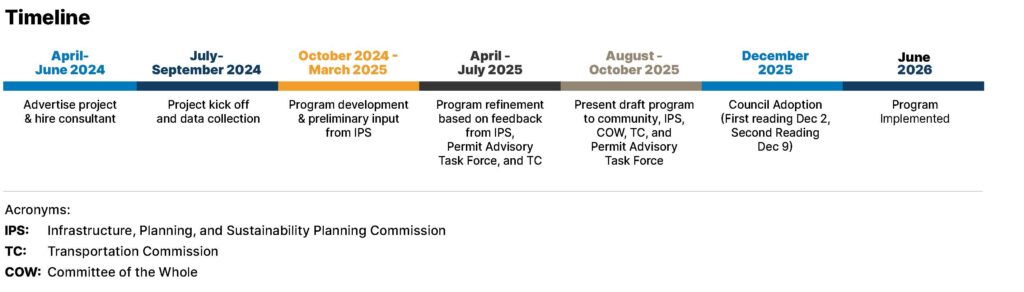
The Tacoma City Council has taken a significant step toward facilitating a safer, more connected, and equitable future for Tacoma’s transportation network. With the passage of Ordinance 29082 amending Chapter 10.31 of the Tacoma Municipal Code, the City Council has authorized the collection of transportation impact fees effective June 1, 2026.
Read the ‘Transportation Impact Fees to Help Fund Critical Infrastructure and Enhance Safety’ news release for more information.
Background
-
The City of Tacoma has experienced significant growth over the past decade. While this expansion has offered new residential opportunities, local jobs, and services, it has also strained the public infrastructure, including roads, parks, schools, and emergency services that our community relies on. The City is committed to providing public infrastructure that meets the needs of our community and impact fees are a potential source for funding this infrastructure.
Like many local agencies, the City of Tacoma has a significant gap in infrastructure funding. While the City Council and voters have taken meaningful and responsible measures to address some of this need—particularly when it comes to maintaining existing transportation infrastructure—the investments required to accommodate future growth are still underfunded.
The City of Tacoma adopted Transportation Impact Fees to help fund resources that all Tacomans use—things like roads, sidewalks, bike lanes, and trails. Transportation Impact Fees are one-time charges to new developments to help fund a portion of the costs of new infrastructure needed to support new growth.
Watch the short video below to learn more about Transportation Impact Fees and how they could benefit our community.
-
- Transportation Impact Fees are based on how many trips the new development would create. For example, a single-family home would have much less impact than a large grocery store, so the fee would be substantially less for a home. The greater the impact a new development would have on our transportation system, the higher its rate would be.
- Impact fees would apply to all types of development that affect the transportation system in different ways—like housing, retail establishments, movie theaters, hospitals, offices, and manufacturing. The impact fee rate would be higher for land use categories that generate more trips and lower for categories that generate fewer trips.
- Impact fees would be one of many tools that helps pay to build Tacoma’s transportation system—along with federal and state grants, gas tax revenues, local taxes you pay, and other sources.
-
- Tacoma’s impact fee program was developed to reflect Tacoma’s values: integrity, service, excellence, and equity. This means consistency with major city initiatives like Home in Tacoma, which paves the way for more diverse, affordable, and sustainable housing options in Tacoma.
- The City’s impact fee program provides robust exemptions and reductions for low-income housing and middle-housing, ensuring that this program continues to encourage affordable housing, while also helping build and sustain the transportation options that people traveling to and from these new developments will need.
-
- Transportation Impact Fees pay for specific projects that are on the impact fee project list. This list would be updated every few years with input from the public.
- Each project on the list is expected to be built using a combination of impact fee funds plus funding from grants or other sources. Examples of projects that could be funded by impact fees include: Complete Streets improvements on 6th Avenue in North Tacoma; development of a protected bikeway on Tyler Street in South Tacoma; and intersection updates, like the 21st and C Street intersection in Downtown Tacoma.
-
- Impact fee revenues cannot be used to fund things like pothole repair, transit service hours and transit vehicles, and operations and maintenance costs.
- However, funds can be used for things that add new capacity such as:
- Streets and roadway realignments.
- New bikeways and bicycle facilities.
- Sidewalks.
- Pedestrian crossings.
- Turn lanes.
- Signal upgrades and roundabouts that make our intersections more efficient.
-
- The City of Tacoma crafted its Transportation Impact Fee program to help fund high-priority transportation projects across the city. The projects included in the program vary in terms of complexity and cost, and most are active transportation projects, improving capacity for people walking, rolling, and bicycling.
- See the full list of eligible projects.
Additional Resources
News Release - Transportation Impact Fees to Help Fund Critical Infrastructure and Enhance Safety
Ordinance No. 29082
City of Tacoma Impact Fee Framework November 2021 (completed by Fehr & Peers and Berk Consulting)
Fee Memo August 2018 (completed by Fehr & Peers and Berk Consulting)
Municipal Research Services Center (MRSC) Impact Fee Website
American Planning Association (APA) Policy Guide on Impact Fees
Transportation Impact Fees (TIF) Calculator
Use the TIF Calculator to estimate the amount of traffic impact fees required for various projects. This calculator is for estimates only. Final fee amounts will be calculated by the City of Tacoma. To use the TIF Calculator, please download it and open it in Excel.
Tip Sheet
Contact
TIF Calculator
Use the TIF Calculator to estimate the amount of traffic impact fees required for various projects. This calculator is for estimates only. Final fee amounts will be calculated by the City of Tacoma. To use the TIF Calculator, please download and open in Excel.