Critical Areas Ordinance Update

Contact
Robin Bolster-Grant, Land Use Division Manager
Lisa Spadoni, Natural Resources Program Supervisor
Questions regarding the update may be directed to CAOUpdate@tacoma.gov.
The City Council adopted the updated Critical Areas Preservation Ordinance (Amended Substitute Ordinance No. 29114) on July 14, 2026. The effective date of the updated regulations is 10 days after the City Council decision is posted in the newspaper.
Critical Areas Information Cards
- Wetlands
- Fish and Wildlife Habitat Conservation Areas (FWHCA)
- Critical Aquifer Recharge Areas
- Frequently Flooded Areas
- Geological Hazard Areas
Why are we updating the Critical Areas Ordinances Now?
Under Washington State Law, all counties and cities in the state must conduct a periodic review and update of their critical areas regulations. This happens every 10 years as we review and update our Comprehensive Plan, which guides the growth anticipated in the City in the next 20 years. The Comprehensive Plan update process includes extensive public outreach to update City policies and goals regarding environmental protections. The CAO periodic update provides an opportunity for the City to make sure our regulations are consistent with the updated Comprehensive Plan policies, federal and state policies, and incorporate scientific advancements related to environmental conservation and natural hazards.
The City has produced a report on the Best Available Science (BAS) that will be incorporated into these regulations and a Gap Analysis that identifies regulations that need to be updated based on BAS.
Critical Areas Ordinance Update Process
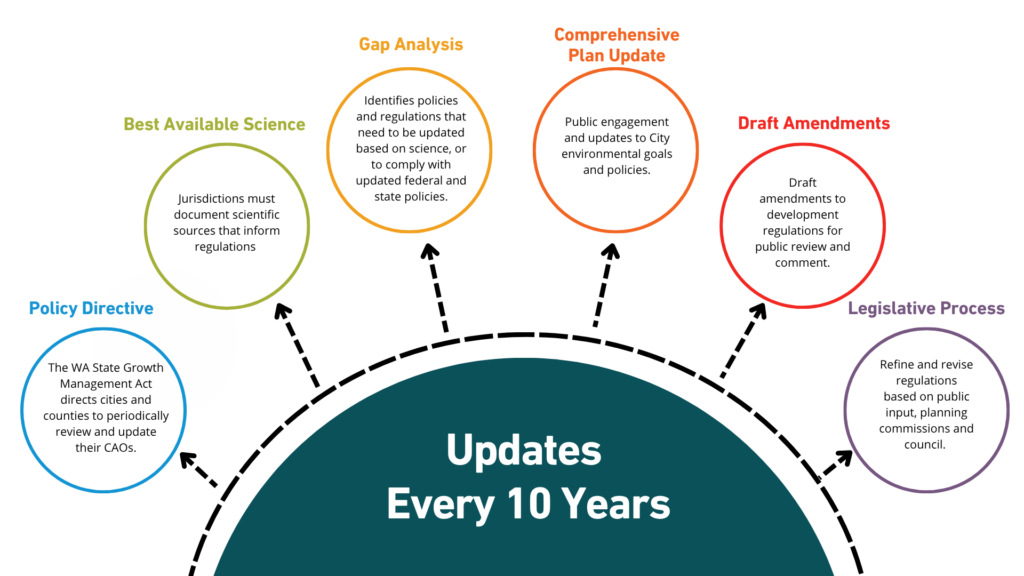
✓ Policy Directive: Washington State law requires cities and counties to update CAO regulations every 10 years as part of the Comprehensive Plan update.
✓ Best Available Science and ✓ Gap Analysis: as part of the Comprehensive Plan update, the City produces a report on Best Available Science and a Gap analysis to determine what regulations need to be updated based on BAS.
✓ Comprehensive Plan Update: The Comprehensive Plan update entails extensive public outreach to update City goals and policies regarding environmental resources. The Comprehensive Plan update concluded at the end of June 2025.
✓ Draft Amendments: City consultants drafted updated CAO regulations and definitions for public review and comment.
✓ Legislative Process: Revised regulations based on public comment, Planning Commission, and City Council final adoption of updated CAO.
-
Expected timeline for City Council review and adoption: May – June 2026
Meeting Title Date Purpose/Links Planning Commission May 21, 2025 Introduction of CAO update, Best Available Science and Gap Analysis
Planning Commission Packet (05-21-25)
Planning Commission Presentation
RecordingPlanning Commission June 18, 2025 Review of CAO key update topics
Planning Commission Packet (06-18-25)
Planning Commission Presentation
RecordingPlanning Commission July 16, 2025 Request to set a public hearing and release the draft code for public review
Draft CAO Update
Planning Commission Packet (07-16-25)
Planning Commission Presentation
RecordingPublic Informational Meeting August 7, 2025 Public Information Meeting Presentation Planning Commission Public Hearing August 20, 2025 Public Hearing
Link to draft code
CAO SEPA DNS
Planning Commission Packet (08-20-25)
Planning Commission Presentation
RecordingPlanning Commission September 17, 2025 Planning Commission Packet (09-17-25)
Planning Commission Presentation
RecordingPlanning Commission October 15, 2025 Planning Commission Packet (10-15-25)
Planning Commission Presentation
RecordingNature Center Walk and Talk Information Session October 18, 2025 City staff hosted a free information session and Nature Center Walk and Talk to learn how Tacoma is protecting our environment through important updates to the Critical Areas Ordinance Planning Commission January 21, 2026 Planning Commission Packet (01-21-26)
Planning Commission Presentation
RecordingPlanning Commission March 18, 2026 Planning Commission Packet (03-18-26)
Planning Commission Presentation
Draft CAO Update (TMC 13.11)
Draft CAO Update Definitions (13.11.110)
RecordingPlanning Commission April 1, 2026 The Planning Commission voted to recommend approval of the revised draft Critical Areas Ordinance (CAO) and forward it to the City Council. The Planning Commission’s Recommendations and Findings, along with the revised draft CAO code, are available here.
Planning Commission Packet (04-01-26)
Planning Commission Presentation
RecordingSouth Sound Sustainability Expo May 2, 2026 South Sound Sustainability Page Code Amendment Open House May 9, 2026 As part of the public engagement process, the City hosted a Code Amendment Open House at the STAR Center to provide community members with an opportunity to learn more about the proposed updates and ask questions. City Council Study Session May 12, 2026 To review the Planning Commission’s Recommendation and request to set a public hearing for June 2, 2026
Study Session Agenda
RecordingCity Council May 12, 2026 Resolution setting Tuesday, June 2, 2026, as the date for a public hearing.
City Council Agenda
RecordingCity Council Public Hearing June 2, 2026 Public Hearing
Meeting Materials
RecordingCity Council First Reading of Ordinance July 7, 2026 City Council Agenda
Ordinance Materials & Presentation
RecordingCity Council Final Reading of Ordinance July 14, 2026 City Council Agenda
Ordinance Materials & Presentation
Recording -
What regulatory changes were made?
The CAO revisions align with recently updated scientific guidance for wetlands and wetland buffers, and for fish & wildlife habitat areas, particularly stream buffers and Oregon white oak. Wetland and stream buffer sizes were adjusted and new vegetation requirements were added. Requirements for the protection of Oregon white oak were added to the code rather than just references to follow guidance from the Department of Fish and Wildlife. Updates to definitions and procedural provisions were also necessary.
Did the update include general tree retention or planting standards?
No. General tree retention and planting standards are covered in the landscaping section of Tacoma Municipal Code Title 13. Updates to the landscaping standards for trees are being reviewed under the 2026 Tree and Landscape Code Update.
Were Shoreline regulations updated?
No. Shoreline areas are regulated under the Shoreline Master Program (SMP). The City will be working on shoreline code updates in a few years.
What City policies guide the CAO update?
The City Comprehensive Plan contains an Environmental Element. The Environmental Element contains policies and goals that support the establishment and updating of critical areas regulations.
What federal and state agencies make policies that govern a CAO update?
Federal and state agencies that issue policies and best available science include:
The Federal Emergency Management Agency (FEMA)
Washington State Department of Ecology
Washington State Department of Fish and Wildlife
Washington State Department of Natural ResourcesWhat is Best Available Science (BAS)?
Jurisdictions must demonstrate that the best available science has been considered when updating their critical areas ordinance by documenting scientific sources that support their approach to regulating critical areas and explaining when policies depart from science-based recommendations. Best available science can come from other government agencies and from independent research organizations. Chapter 365-195 of the Washington Administrative Code (WAC) serves as a guide for establishing what is considered the best available science.
How will these changes affect my property/development?
The CAO update will only affect properties that have critical areas or critical area buffers on them or nearby. Current regulations limit development in critical areas and buffers. The CAO update will continue to protect these areas and may include revised buffer distances, mitigation provisions, and permit requirements.
How do I know if I have a critical area on my property?
Critical area regulations apply to sites containing critical areas and/or their buffers. Publicly available mapping can be referenced as a guide, but site-specific study by a qualified professional may be necessary to assess site conditions. Public resources for critical area mapping include:
– City of Tacoma DART Map
– Pierce County PublicGIS
What can I do in or near a critical area?
Land uses in or near critical areas are regulated to protect the natural resource and/or to protect human health and safety. Generally, impacts to critical areas and their buffers should be avoided, minimized to the extent feasible, and any unavoidable impacts must be mitigated. Restrictions and permitting requirements for critical areas vary based upon the type, location, and extent of the critical area. Review the CAO or contact the Planning and Development Services Department for specific questions.
What parts of the City are most affected by the CAO update?
Critical areas are present throughout the City. The CAO update may involve modified requirements for each critical area defined by the state.