Parking Code Update

Contact
Maryam Moeinian
Senior Planner
mmoeinian@tacoma.gov
Draft Code and Planning Commission Public Hearing
The Planning Commission released the draft Parking Code Update for public review and held a public hearing on Wednesday, August 5, 2026. The draft code amendments would eliminate minimum off-street parking requirements citywide while retaining standards for parking design, access, landscaping, and other development requirements for parking that is voluntarily provided.
- Draft Parking Code Amendments
- Staff Report
- SEPA File Number: LU26-0129
- Research Background & Technical Analysis
Sign up to Receive Email Updates
Why Is the City Updating the Parking Code?
Washington State has adopted several new laws, including SB 5184 (2025), HB 1183 (2025), and HB 1491 (2025), that limit local authority to require off-street parking. The Legislature found that mandatory parking minimums can:
- Increase housing and development costs
- Encourage auto-dependence
- Discourage walking, biking, and transit use
- Contribute to climate and public health impacts
These laws require cities to eliminate or reduce parking requirements for many housing types, small commercial spaces, developments near transit, and projects such as affordable housing, childcare facilities, and housing created within existing buildings.
Important note: Removing minimum parking requirements does not mean parking would be prohibited or that new development could not provide parking. It means the City would no longer regulate how many parking spaces businesses or developers must provide. Parking decisions would be based on market demand, site conditions, and project needs.
Updating Tacoma’s parking regulations ensures compliance with state law while supporting the City’s adopted goals for housing affordability, walkability, multimodal transportation, and climate action.
Project Timeline
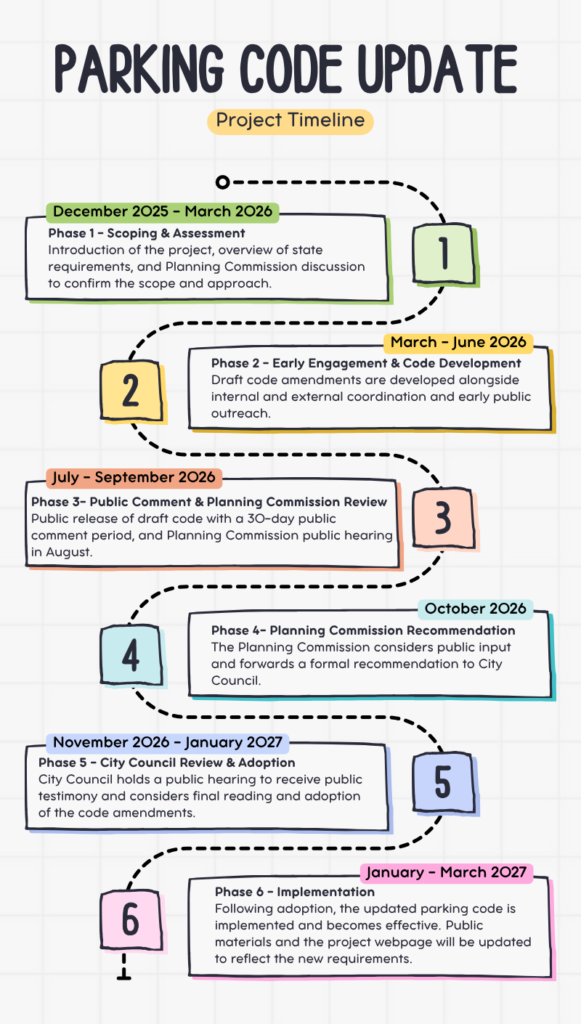
-
The City is committed to a transparent and inclusive engagement process.
Past Meetings Date Meeting Description December 17, 2025 Planning Commission Project overview, state mandates, and discussion of scope options
Agenda
AudioFebruary 19, 2026 Climate and Sustainability Commission Project overview, state mandates, and discussion of scope options
Agenda
Presentation
MinutesFebruary 25, 2026 Infrastructure, Planning, and Sustainability Committee Project overview, state mandates, and discussion of scope options
Agenda
AudioMarch 4, 2026 Planning Commission Project overview, state mandates, and discussion of scope options
Agenda
AudioMay 9, 2026 Code Amendment Open House Event Staff provided information on the Zoning and Land Use Code Amendments currently under consideration by the City of Tacoma July 1, 2026 Planning Commission Released for public review and set a public hearing date for August 5, 2026
Agenda
AudioJuly 15, 2026 Tacoma Permit Advisory Group Agenda
PresentationJuly 15, 2026 Transportation Commission Agenda
Presentation
MinutesAugust 5, 2026 Planning Commission Public hearing
Agenda Packet
Presentation
AudioAugust 6, 2026 Parking Technical Advisory Group Agenda
Presentation
MinutesAugust 20, 2026 Climate and Sustainability Commission Agenda
PresentationSeptember 2, 2026 Planning Commission Agenda Packet
Presentation
AudioSeptember 3, 2026 Parking Technical Advisory Group Agenda September 10, 2026 Tacoma Area Commission on Disabilities Agenda
PresentationAdditional briefings and community engagement opportunities will be added as the project progresses.
-
What is happening?
The City of Tacoma is updating its off-street parking regulations to comply with new Washington State laws and to ensure local parking rules align with Tacoma’s adopted plans and community goals, including housing affordability, walkability, climate action, and multimodal transportation. Recent state legislation significantly limits when and how cities may require off-street parking. As a result, Tacoma is required to update its parking regulations.
The Planning Commission has directed staff to prepare draft code amendments based on a citywide removal of minimum off-street parking requirements. The Draft Parking Code Update reflects this direction and is now available for public review.
This is a draft proposal and has not been adopted. The City Council may modify, retain, or remove elements of the draft during its review and adoption process.
Why is this happening?
In recent years, the Washington State Legislature adopted several new laws, including SB 5184 (2025), HB 1183 (2025), and HB 1491 (2025), that significantly limit how cities can require off-street parking. These laws are intended to:
- Reduce housing and development costs
- Support increased housing production
- Encourage walking, biking, and transit use
- Reduce vehicle dependence, greenhouse gas emissions, and excessive pavement
Tacoma is updating its regulations to comply with these requirements while supporting local planning goals.
Does this Parking Code Update affect street (on-street) parking?
No. This Parking Code Update focuses only on off-street parking for new development and redevelopment, such as parking located on private property, in lots, or in garages. It does not change how street parking is regulated.
On-street parking is managed by the City’s Public Works Department. For more information about on-street parking, please visit On-Street Parking webpage.
What is being considered?
Early in the policy development process, two approaches were evaluated for updating Tacoma’s off-street parking regulations.
Option A: State Mandate Compliance (Minimum Update)
This option would update Tacoma’s parking code only to the extent needed to meet state law. This includes reducing or eliminating minimum parking requirements for specific uses such as:- Affordable housing
- Senior housing
- Small housing/commercial units
- Childcare facilities
- Development near frequent transit
- Housing added inside existing buildings
- Change of use from nonresidential to residential or a change of use for a commercial use
- Certain commercial spaces
- Certain residential projects
Under this approach, minimum parking requirements would remain in place for all other uses not directly affected by state law.
Option B: Broader Citywide Parking Reform
This option would eliminate minimum off-street parking requirements citywide for all development.Parking would still be allowed, but the City would no longer establish minimum parking ratios for any use or zoning district.
Planning Commission Direction
After reviewing both options, the Planning Commission directed staff to proceed with drafting code amendments based on Option B: elimination of minimum off-street parking requirements citywide.The Draft Parking Code Update reflects this direction and is currently under review as part of the public comment process.
What is included in the draft code?
The Draft Parking Code Update includes:- Elimination of minimum off-street parking requirements citywide (draft approach)
- Continued allowance for voluntary provision of parking based on market demand, site conditions, and project needs
- Standards for parking design, access, landscaping, and safety
- Updated accessibility requirements consistent with state and federal regulations
ADA Accessibility Requirements
In the proposed Draft Parking Code Update, ADA accessibility requirements are no longer included in the zoning code and would instead rely on the Building Code and federal ADA Standards for Accessible Design.Under these standards, ADA-accessible parking is required whenever off-street parking is provided. If no off-street parking is provided, ADA parking is not required.
This represents a change from prior zoning code provisions, which included separate ADA parking requirements in certain circumstances.
All development that provides parking must comply with applicable ADA and Building Code requirements.
This provision is part of the draft code and may be modified through Planning Commission and City Council review.
Who would be impacted?
The update may affect:
- Residents, including renters and homeowners
- Businesses and property owners
- Developers and builders
- Some zoning districts and uses are already exempt from minimum parking requirements and may see little or no change.
What is the timeline?
The project is expected to be adopted by October 2026. Key milestones include:
- Scoping & assessment: December 2025 – March 2026
- Code development: March – June 2026
- Draft code review & Planning Commission recommendation: July – October 2026
- City Council review & adoption: November 2026 – January 2027
- Public engagement December 2025 – January 2027
What has already happened?
- The Parking Code Update was introduced to the Planning Commission in December 2025.
- Staff presented Washington State law requirements and initial policy approaches
- Two policy options were evaluated (State Mandate Compliance and Citywide Parking Reform)
- The Planning Commission directed staff to proceed with drafting amendments consistent with Option B (citywide elimination of minimum parking requirements)
What is already decided:
- Tacoma is required to update its parking code to comply with Washington State law
- The Planning Commission has directed staff to draft amendments removing minimum off-street parking requirements citywide
- ADA requirements will be governed by local, state and federal building code standards
- Off-street parking will continue to be allowed but not required
What is not yet decided:
- Final code language and technical standards
- Specific design and operational requirements for parking
- City Council action on the draft amendments
What type of input are we looking for?
The City is looking for input on:
- How parking requirements affect housing affordability, businesses, and neighborhoods
- Experiences with parking availability and demand
- Potential benefits or concerns related to eliminating parking minimums
- Alternative strategies to manage parking demand, such as shared parking, permit programs, or better transit access
Public feedback will help inform both the scope of the update and specific code changes.
Are there costs/impacts?
There is no direct fee associated with the code update itself.
Potential impacts may include:
- Reduced development costs due to elimination of minimum parking requirements
- Greater flexibility in site design and building form
- Changes in how parking is provided in new development
- Reduced impervious surface area, supporting stormwater management, tree canopy, and urban design goals
Any broader impacts will be evaluated as part of the code development and public review process.
How can I share my input?
- Review project updates and materials as they are released
- Participate in surveys, virtual open houses, public meetings, and hearings
- Share your experiences and ideas about parking in Tacoma
- Provide comments during the public review period
Your input will help shape how Tacoma updates its parking regulations to meet state law and community needs.
What are some myths versus facts?
Myth: The City is banning parking.
Fact: The City is not proposing to ban parking. The update removes minimum requirements but continues to allow parking to be provided.Myth: New buildings won’t provide any parking at all.
Fact: Removing minimum parking requirements does not mean parking won’t be provided. Many developments continue to include parking based on market demand, financing requirements, tenant needs, and site constraints. The change would give flexibility, not eliminate parking.Myth: ADA parking requirements are going away.
Fact: ADA requirements remain in place under Building Code, state and federal law and apply whenever parking is provided.Myth: This means neighborhoods will be flooded with cars.
Fact: State law already limits how much parking cities can require, especially near transit and for certain housing/commercial units. The City can still use other tools, such as street design, curb management, and permit programs, to manage parking impacts where needed.Myth: The City is doing this voluntarily.
Fact: Tacoma is required by state law to update its parking code. The specific approach is determined through the City’s local policy process and City Council review.Myth: Parking requirements are the best way to prevent traffic and congestion.
Fact: Research and state legislative findings show that excessive parking requirements can increase development costs, encourage more driving, and reduce walkability. Parking supply alone does not manage traffic. Access to transit, walking, biking, and land use patterns also play a major role.Myth: This only benefits developers.
Fact: Reducing mandatory parking can benefit residents and businesses by lowering housing costs, supporting smaller and more affordable projects, reducing unnecessary pavement, and allowing land to be used for housing, trees, or community space instead of empty parking stalls.